Dolphin Floral Circle Vector Design
A Minimalist Leap That Lands Just Right
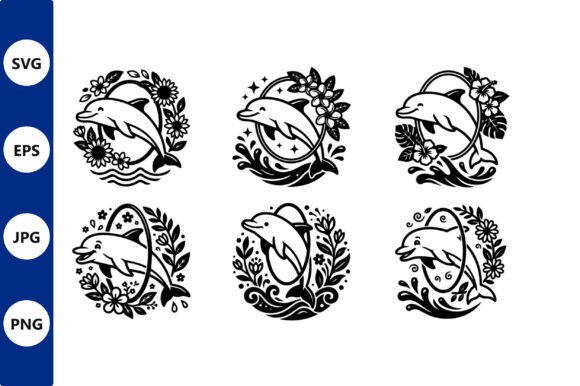
First glance at the Dolphin Floral Circle Vector Design feels like catching your breath mid-sentence—clean, intentional, and quietly joyful. The dolphin arcs with gentle confidence inside a circular frame woven from flowers, leaves, and soft wave lines. It’s not fussy. It’s not loud. It’s black-and-white line art that speaks in quiet authority: thoughtful, coastal, calm—but never dull. As someone who’s stitched hundreds of designs onto everything from baby onesies to boutique aprons, I immediately saw its home: a custom embroidered tote bag for a local ocean-themed nursery shop. Not as a centerpiece shouting for attention, but as a subtle, meaningful accent—just above the seam, on the front pocket, where customers pause, smile, and say, “Oh—I *get* that.”
Where This Design Truly Shines (and Why)
The Dolphin Floral Circle Vector Design thrives where clarity and charm matter more than complexity. It works beautifully on sweatshirt embroidery—especially lightweight cotton blends—because its open negative space lets fabric breathe and stitch lines stay crisp. On tea towels? Perfect. The circular boundary reads cleanly even after repeated washing, and the line weight holds up without bleeding or filling in. As a machine embroidery design for baby embroidery, it reads as soft and safe—not too busy, not too sharp—ideal for onesies, burp cloths, or crib mobiles. And for Etsy sellers offering personalized gifts, it’s a quiet standout: pair it with a monogrammed initial inside the circle, and you’ve got a cohesive, boutique-ready embroidered patch or pillow cover.
It also translates well into digital embroidery file previews and printable mockups. Because it’s vector-based and minimalist, resizing doesn’t degrade detail—so whether you’re showing a client a 2-inch cap front or a 4-inch tote bag application, proportions stay balanced. That reliability makes it strong design assets for small shop product listings, craft fair displays, or holiday embroidery collections where consistency builds trust.
Where to Pause—and Test First
This isn’t a one-size-fits-all embroidery file. Its elegance depends on execution. On stretchy fabric like jersey or thin knit t-shirts, the outer floral frame can blur if stabilizer isn’t layered thoughtfully—use a medium-weight cutaway + tear-away combo, not just basic iron-on. On dark fabric, test thread colors carefully: a single-tone black satin stitch may disappear; consider navy or deep teal for contrast while keeping the minimalist mood. And on curved surfaces—like the front of a structured cap—the circle’s symmetry can distort slightly if hooping isn’t precise. Always run a test on scrap fabric first, especially if stitching dense fill stitch within tight corners of the wave elements.
Also note: because it’s line art—not an applique design—it relies entirely on stitch definition. Avoid ultra-fine threads or low-density running stitch for the main outline. You want clean, confident lines—not sketchy, hesitant ones. If your embroidery project includes layered garments (like a linen apron over a cotton shirt), confirm hoop size allows full-circle clearance—no part of the frame should get cut off mid-stitch.
What It Adds to Your Finished Product
Used well, the Dolphin Floral Circle Vector Design lifts perceived value without raising production complexity. Customers notice craftsmanship in restraint: the way the dolphin’s curve mirrors the circle’s edge, how the floral elements flow without crowding, how little ink—or thread—is needed to say something memorable. That translates directly to handmade presentation and brand consistency. For a craft business selling coastal-themed kitchen towels, it signals intention—not trend-chasing. For a wedding gift—a set of embroidered napkins—it feels personal, not mass-produced. And for commercial embroidery clients, it reads professional: scalable, licensable, and versatile across mediums (from printed labels to embroidered patches).
Practical Designer Notes Before You Stitch
- Always test on scrap fabric matching your final garment’s weight and texture—especially for baby embroidery or holiday embroidery where durability matters.
- Review stitch density: this design doesn’t need heavy fill stitches, but don’t under-digitize the dolphin’s outline—running stitch alone may lack presence on textured fabrics.
- Check hoop size compatibility: the circular layout demands at least a 4-inch hoop for comfortable stitching; smaller hoops risk awkward re-hooping or distorted curves.
- Inspect small details before sending to machine—the tips of leaves and wave ends are delicate; ensure they’re digitized with enough stitch length to hold.
- Test black-and-white mockups on both light and dark backgrounds—you’ll quickly see where contrast needs adjusting in thread color choice.
- Confirm licensing before selling finished products or digital embroidery files—this is a Graphics asset intended for commercial use, but verify terms match your craft business model.
- Use proper stabilizer: lightweight tear-away works for stable cottons; add cutaway for knits, terrycloth, or anything that shifts during stitching.
Final Thought: A Design That Earns Its Place
The Dolphin Floral Circle Vector Design doesn’t shout. It invites. It’s the kind of Illustrations piece that grows on you—and on your customers—as it lives in the world: on a child’s backpack, a barista’s apron, a guest towel folded beside a bathroom sink. It works because it balances theme and restraint, playfulness and polish. If you’re choosing embroidery design assets for real projects—not just pretty thumbnails—this one earns its spot in your working library. Just remember: minimalism only reads as intentional when the execution is precise. So test, tweak, and trust your eye. Then stitch it with confidence.